How to Build a Reddit Keyword Strategy for Demand Monitoring
A practical guide to choosing Reddit keywords for demand monitoring: group phrases by intent, cut noise with exclusions, use subreddit filters, and build a repeatable keyword framework.
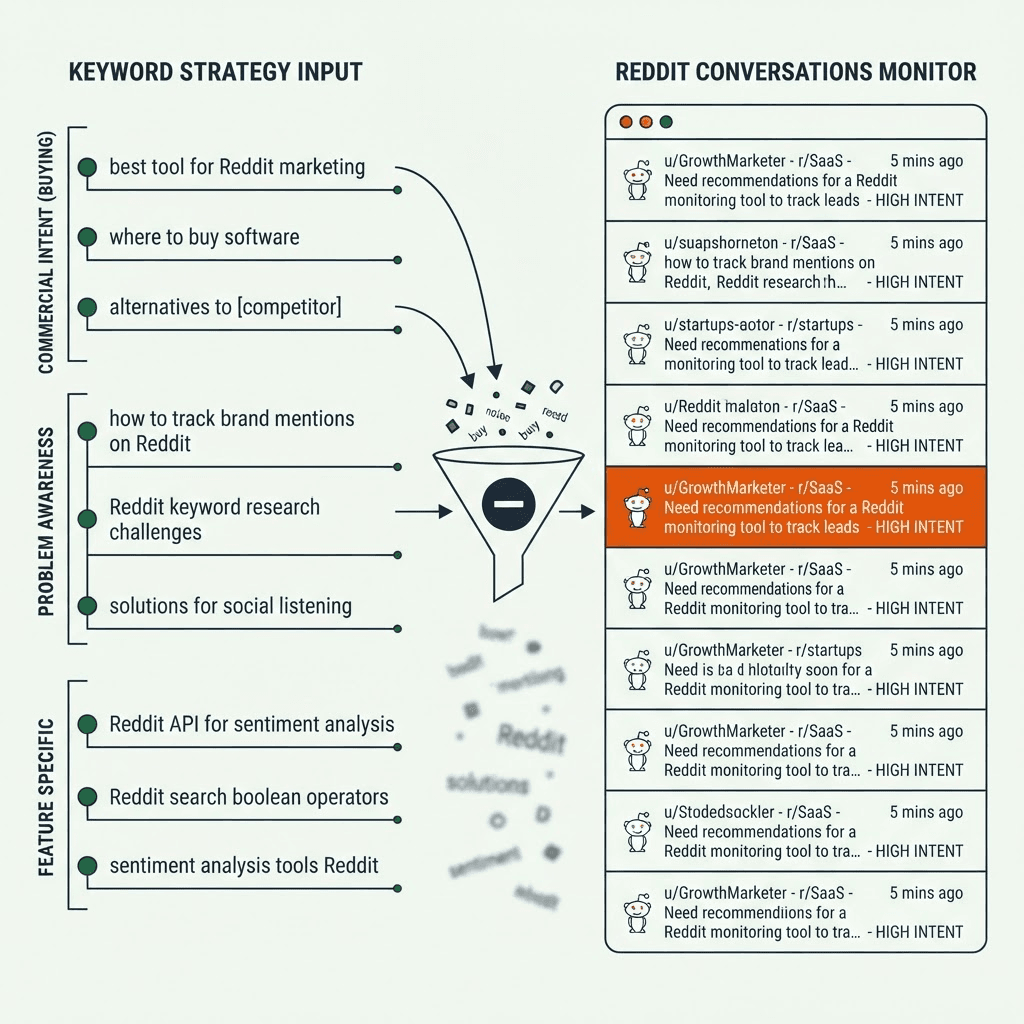
Reddit is packed with demand signals. People ask for product advice, complain about pricing, compare competitors, and describe broken workflows in plain language. Raw keyword monitoring usually misses that. Track only your company name or one broad term, and you get either silence or junk: memes, job posts, news, and academic threads. This guide shows how to build a repeatable Reddit keyword strategy that catches buying intent, product pain, and recommendation requests. Use it to sharpen your Reddit demand tracking, build better keyword trackers, and improve social listening for real demand signals.
Why single-term monitoring breaks
Tracking one company name, product name, or industry term is the lazy default. In practice, it fails in three ways: low recall, high noise, and missed language.
- Low recall. People rarely type "project management" when they mean "I need a task board for a small agency." They describe the job: "how do you track client approvals?"
- High noise. Broad terms pull in job posts, memes, theory debates, and academic threads instead of buying signals.
- Missed language. Buyers say "any good alternatives to X?" or "looking for a lightweight Kanban." Your product name never appears.
The goal is not brand mentions. It is intent and context. That means grouping keywords by purpose and filtering hard.
Group keywords by signal type
Organize keywords into groups. Each group should capture a specific signal.
- Product category terms
- Generic but specific: "task management tool," "project tracker," "team wiki"
- Purpose: catch category interest. Use sparingly and pair with subreddit filters.
- Customer problems
- Symptom language: "can't keep track of deadlines," "lost client feedback," "too many versions of files"
- Purpose: find people describing pain your product solves.
- Buying-intent phrases
- Explicit intent: "looking for," "need a tool," "any recommendations for," "best tool for"
- Purpose: highest-priority signals. Alert on these.
- Recommendation requests
- Q-style queries: "what's the best X for Y?" "recommend a X for freelancers"
- Purpose: prospecting and outreach opportunities.
- Competitor names
- Competitors and abbreviations: "Asana," "ClickUp," "Trello," "Wrike," "asana vs"
- Purpose: catch switch and comparison threads.
- Alternative searches
- Phrases like "alternative to Asana," "better than Trello," "switching from Monday.com"
- Purpose: find people evaluating replacements.
- Workflow questions
- Process language: "how do you manage client approvals," "how to share timelines with clients"
- Purpose: surface content ideas and early demand.
- Feature requests
- Feature asks: "need built-in GANTT," "snooze notifications," "custom fields"
- Purpose: reveal roadmap demand.
- Integration requests
- Ecosystem asks: "integrates with Slack," "Zapier integration for X"
- Purpose: show partnership and developer demand.
- Pricing complaints
- Commercial friction: "project tool too expensive," "pricing changed," "limit on projects"
- Purpose: catch churn and switching triggers.
- Natural language and colloquialisms
- Real phrasing: "I use it for client work," "our team uses boards for QA"
- Purpose: avoid overfitting to marketing copy.
These groups give your monitoring plan structure. Each one maps to a different response from sales, marketing, support, or product.
Example: project-management software
Here is what this looks like for a project-management vendor. If you only track "project management," you will collect academic posts, job ads, and off-topic threads. Build trackers across groups instead.
- Product category terms: "task management tool," "project tracker for agencies," "team task board"
- Customer problems: "clients miss deadlines," "hard to get approvals from clients," "file/version chaos in projects"
- Buying-intent phrases: "looking for a task management tool," "need a lightweight project tracker," "any tools for client billing and tasks"
- Recommendation requests: "best tool for managing creative projects?" "recommend a PM for consultants"
- Competitor names: "Asana," "alternative to Asana," "switched from Trello"
- Alternative searches: "asana alternatives," "better than ClickUp for clients"
- Workflow questions: "how do you manage client approvals?" "how to track client feedback in tasks?"
- Feature requests: "need built-in proofing," "time tracking + tasks combo"
- Integration requests: "integrates with QuickBooks?" "Slack integration for task comments"
- Pricing complaints: "project tool too expensive," "pricing limit on seats"
- Natural language: "I need something simple for my freelancers," "we use boards but want lists"
Why these work: "looking for a task management tool" and "recommend a PM for consultants" show explicit intent. "Alternative to Asana" catches switchers—the same signal we cover in depth in tracking competitor mentions on Reddit. "How do you manage client approvals" exposes real workflow pain. "Project tool too expensive" signals churn. All of them have a better signal-to-noise ratio than "project management."
Use exact phrases for intent, broader matching for discovery
You need both exact phrase matching and broader conceptual matching. They solve different jobs.
-
Exact phrase matching (quoted phrases, strict regex): high precision, lower recall. Use it for high-priority intent phrases like "looking for a task management tool" or "alternative to Asana." These should trigger alerts.
-
Broader conceptual matching (word sets, fuzzy match): higher recall, more noise. Use it for category terms and symptom language where phrasing varies. Example: match any post containing at least one word from {"task","project","tracker"} and one word from {"tool","software","app"}.
Practical rule: start strict for buying-intent and competitor terms. Use broader patterns for problem and workflow groups. Then trim false positives with exclusions.
Handle variations and filter by subreddit
Reddit language is messy. Your tracker has to account for that.
- Singular/plural: include both "tool" and "tools," "task" and "tasks."
- Abbreviations: include short forms like "PM tool." Also watch for shorthand such as "SaaS PM" or "Kanban app."
- Misspellings: add common typos for high-value keywords, but only after you see them in the wild.
- Case and punctuation: most tools ignore case. Strip punctuation where possible.
- Subreddit filtering: cut noise by focusing on relevant subreddits such as r/Entrepreneur, r/marketing, r/SmallBusiness, r/ProductManagement, r/Agency, and r/freelancing. Start broad, then tighten. Example: "project tracker" in r/Academia often means research methods, not software.
Also add rules for noisy, cross-post-heavy subreddits like r/technology and r/news. Use allow-lists for high-signal streams. Use deny-lists for communities that overlap with your keywords but rarely contain demand.
Your buyers are already talking on Reddit.
TrackDemand watches Reddit for your keywords, competitors, and pain phrases, then AI-scores every conversation into leads, research, and client-ready reports.
Explore TrackDemand.aiUse exclusions to kill noise
Filtering matters as much as keyword selection. Use negative keywords, regex, and subreddit rules to cut false positives.
Common exclusion buckets:
- Job posts: "hiring," "job," "resume," "apply," "position." Add NOT (hiring OR job OR resume) when you want product demand, not recruiting.
- Memes and jokes: "meme," "shitpost," "lol," "jokes," plus meme-heavy subreddits. Exclude those communities or down-rank very short posts.
- News and academic content: "research paper," "study," "university," or subreddits like r/AskAcademia. Exclude them if you want buyer signals.
- Ambiguous words: some terms have competing meanings. Example: "board" could mean surfboard. Require extra context such as "task," "project," or "team."
Example exclusion rules:
- Exclude posts matching:
/\b(hiring|job|resume|apply|interview)\b/i - Exclude short/noisy posts: posts with < 30 characters
- Require context for ambiguous words: include only if
/\b(board|task|project)\b/iis present along with/\b(tool|app|software)\b/i
Apply exclusions carefully. Review them weekly so you do not filter out valid leads.
Run a small tracker first, then expand
A tracker should evolve. Static keyword lists rot.
Step-by-step:
- Start with a focused seed set of 20–50 phrases across the main groups. Include strict buying-intent phrases and a few competitor and alternative patterns.
- Run the tracker for two weeks. Collect results in a spreadsheet or monitoring tool and tag each post: "signal", "noise", or "edge case".
- Find false positives and add exclusions. If job posts dominate, add the job negative set.
- Look for new customer language. If people keep saying "client proofs," add it to feature and workflow groups.
- Expand slowly. Add broader conceptual matches and subreddit filters only after refining exclusions.
- Automate alerts for the highest-priority signals: "looking for", "alternative to [competitor]", "tool too expensive".
- Review results monthly. Archive stale keywords and maintain a stop-word list.
Monthly review checklist:
- Are buying-intent alerts too noisy or too sparse?
- Which exclusions removed legitimate leads?
- What new colloquial phrases appeared?
- Are competitor alerts catching switch signals?
- Do any subreddits belong on the allow-list or deny-list?
Favor precision for outreach. High recall is fine for research. It will swamp SDRs and product teams if you pipe everything through. Before anything reaches sales, score it the way we describe in separating real Reddit buying signals from noise.
A reusable keyword-planning framework
Use this framework for any product.
- Define signal priorities (score 1–5): buying intent=5, competitor switches=4, feature requests=3.
- For each priority, list 8–12 seed phrases with variations. Example for buying intent: "looking for a task management tool", "any recommendations for X?", "need a lightweight project tracker".
- Assign a match type to each phrase: exact, fuzzy, or boolean. Example: exact for "alternative to Asana," fuzzy for symptom language.
- List subreddits to include and exclude. Keep an allow-list of 5–15 high-value subreddits.
- Build exclusions: job terms, meme signals, news and academic triggers, and disambiguation rules for ambiguous words.
- Pilot for two weeks, tag results, and iterate.
Template:
[Group] | "phrase or pattern" | MatchType | Priority(1-5) | SubredditsAllow | Exclusions
Example line:
Buying-intent | "looking for a task management tool" | exact | 5 | r/SmallBusiness,r/freelance | hiring, job, meme
This keeps trackers auditable and easy to share across marketing, product, and sales.
Measure signal quality and avoid the usual mistakes
Watch these metrics:
- Signal rate: percent of hits tagged "signal" vs "noise." A good starting target is >20%, then improve from there.
- High-priority alerts per week: count real buying-intent posts.
- New language discovery count: number of new phrases added each month.
Common mistakes:
- Overfitting to marketing language. Customers do not talk like your homepage.
- Ignoring subreddit context. One high-volume subreddit can drown useful signals.
- Adding exclusions without review. Over-aggressive negatives kill valid leads.
- Trying to capture everything. Focus on the top 2–3 signal groups tied to business outcomes.
Route posts to the teams that can act on them. Send buying-intent posts to sales or community managers. Send feature requests to product. Treat Reddit monitoring as a cross-functional source of qualitative demand.
Technical tips and example queries
A few technical choices improve detection fast:
- Boolean: require context with AND/OR. Example:
("alternative to Asana" OR "asana alternatives") AND NOT (hiring OR job) - Proximity: where supported, require words to appear within N words of each other. This helps with ambiguous terms.
- Regex examples:
- Exclude jobs:
/\b(hiring|job|resume|apply|interview)\b/i - Require context for "board":
/(?=.*\b(board|boards)\b)(?=.*\b(task|project|team|kanban)\b)/i
- Exclude jobs:
- Post-length heuristics: treat very short posts as low quality. Set a minimum character count for high-priority alerts.
- Monitor comments too. Many recommendation requests show up there, not in the original post.
If your tool supports tagging, add automated tags for competitor mentions, pricing complaints, and feature requests. That makes routing easier. A purpose-built platform like DataJelly TrackDemand handles this end to end: it watches subreddits for your keywords, competitors, and pain phrases, then AI-scores every conversation into buyer-intent leads, research, and reports.
How this fits into production monitoring
Reddit keyword monitoring is a practical way to capture buyer language. Start with intent-heavy phrases. Expand into problem and workflow language. Tighten the stream with exclusions and subreddit filters. The same method works for product, pricing, integration, and competitor signals.
If you want browser-rendered evidence tied to conversions, pair demand signals with production monitoring. Example: if Reddit posts spike around "add-to-cart missing," compare that chatter with silent checkout failures in your store. Tools like DataJelly Guard help detect silent revenue-page failures and collect rendered evidence such as screenshots, rendered HTML, and console errors. That gives teams a way to compare customer complaints with what the page actually did.
Keep it lean. Start with 20 focused phrases. Review the results after two weeks. Then expand based on how Reddit users actually talk.
Start with 20 high-intent phrases, run them for two weeks, tag every hit, and cut the junk. You will learn more from real Reddit language than from tracking your brand name alone.
Your buyers are already talking on Reddit.
TrackDemand watches Reddit for your keywords, competitors, and pain phrases, then AI-scores every conversation into leads, research, and client-ready reports.
Explore TrackDemand.ai