1
Identify the visitor
Edge checks the request at the network layer and classifies it as a human browser, search crawler, AI agent, social preview bot, or monitoring request.
DataJelly Edge was sunset in June 2026
Due to changes in the market, DataJelly Edge services were retired in June 2026. We are not accepting any new customers for Edge. The information below is kept for reference. For the full story, read our update on the blog.
Read the Edge sunset updateThe Visibility Layer for JavaScript Apps
Prerendered HTML for search. Clean Markdown for AI. Rich metadata for social. Your unchanged SPA for humans — all from one DNS change, deployed at the edge, no rebuild required.
Live request routing
Human visitor
your-app.bundle.js
Googlebot
rendered.html
ChatGPT-User
page.md
TwitterBot
og:image + meta
~25ms
edge latency
0
code changes
100%
bot coverage
JavaScript apps are invisible to the machines that matter most. Edge fixes this automatically — no rebuilds, no framework changes.
Google, Bing, and DuckDuckGo see an empty shell — no content, no metadata, no rankings.
ChatGPT, Perplexity, and Claude can't extract answers from JavaScript — your site is skipped entirely.
Links shared on Slack, LinkedIn, and Twitter show blank cards — no title, no image, no clicks.
Humans get your live SPA. Search engines get fully rendered HTML. AI agents get token-efficient Markdown. Social bots get optimized metadata. All automatic, all at the network layer.
This affects React, Vue, Angular, Vite, and every AI-built app from Lovable, V0, Bolt, and Replit.
See exactly what Google, ChatGPT, and social platforms receive from your site.
Find out in under 1 minute:
Test your visibility on social and AI platforms(No signup required)
Make your site visible to AI and search in three simple steps. No config. No code.
Make a quick DNS change. No code changes. No tool changes.
Your app gets rendered. HTML for search. Markdown for AI.
Humans see your app unchanged. Bots see everything.
What DataJelly does when a bot visits your site
Identify incoming crawler type
Execute JavaScript fully
Pull structured HTML + text
Create AI-optimized output
Route to bot or human
Use Edge or Guard on their own — or combine them for complete visibility and protection.
Make your site visible to search engines and AI — instantly.
Make sure your pages actually work in production — not just return 200.
Better Together
Edge makes your content visible. Guard makes sure it never breaks.
Use either product on its own — or combine them for the full system.
DataJelly Edge sits between your domain and your app. Every visitor gets the right format — automatically.
Your SPA loads normally — fast, interactive, unchanged.
Google and Bing receive fully rendered HTML snapshots with clean metadata.
ChatGPT, Perplexity, and Claude get structured Markdown for accurate citations.
Twitter, LinkedIn, and Slack get proper OG metadata for rich link previews.
Edge is not a script you add to the page. It runs before the page loads, which means crawlers can receive complete, purpose-built content without waiting for client-side JavaScript to render.
Edge checks the request at the network layer and classifies it as a human browser, search crawler, AI agent, social preview bot, or monitoring request.
Humans receive your normal app. Search crawlers receive rendered HTML. AI agents receive clean Markdown. Social bots receive stable metadata and preview assets.
Snapshots, Markdown, redirects, and metadata are delivered before your JavaScript bundle needs to execute, reducing bot wait time and crawl waste.
DataJelly tracks snapshot freshness, bot activity, crawl trends, Search Console performance, and route-level visibility so teams can prove what changed.
Connect Google Search Console to DataJelly and view organic clicks, impressions, average position, top queries, bot traffic, AI crawler activity, and snapshot health in one dashboard.
Overlay bot crawl volume with Google Search clicks and impressions to see whether crawling changes line up with ranking movement.
Detect crawl drops, ranking changes, weak CTR, and visibility gaps with severity labels and recommended actions.
Compare search bots, AI crawlers, programmatic bots, and social preview bots against organic performance.
Review top queries, average positions, click trends, and impression trends without leaving the Edge workflow.
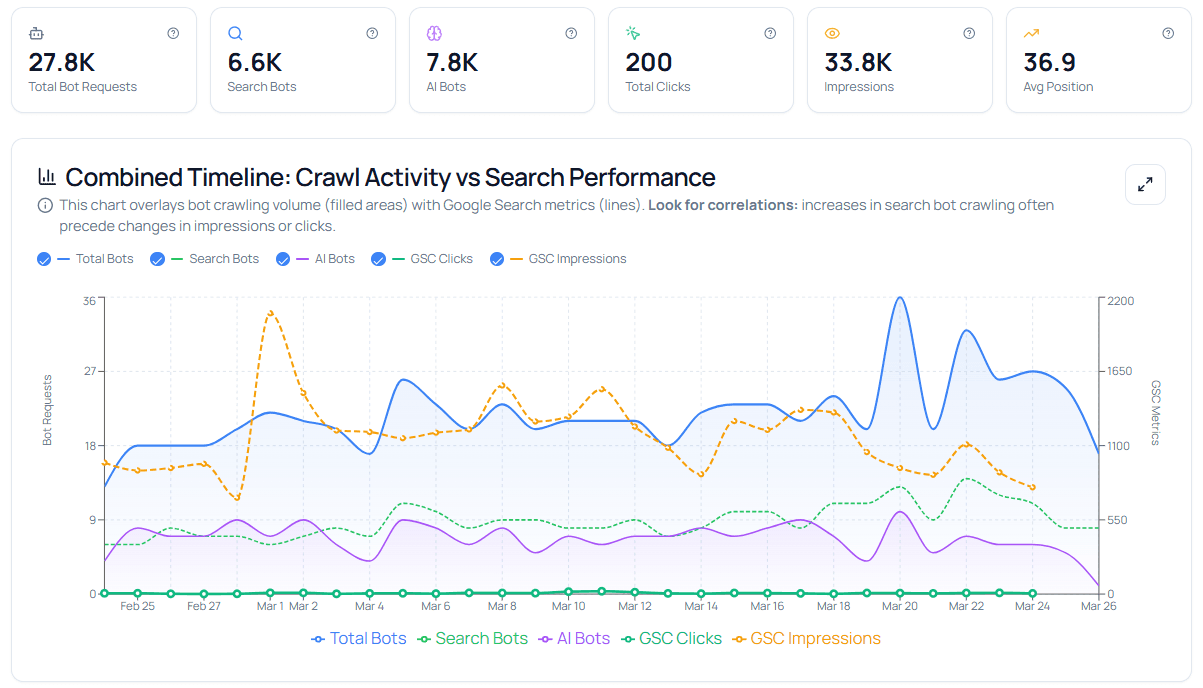
Overlay bot crawl volume (Total, Search, AI) with Google Search Console clicks and impressions to spot correlations between crawling spikes and ranking changes.
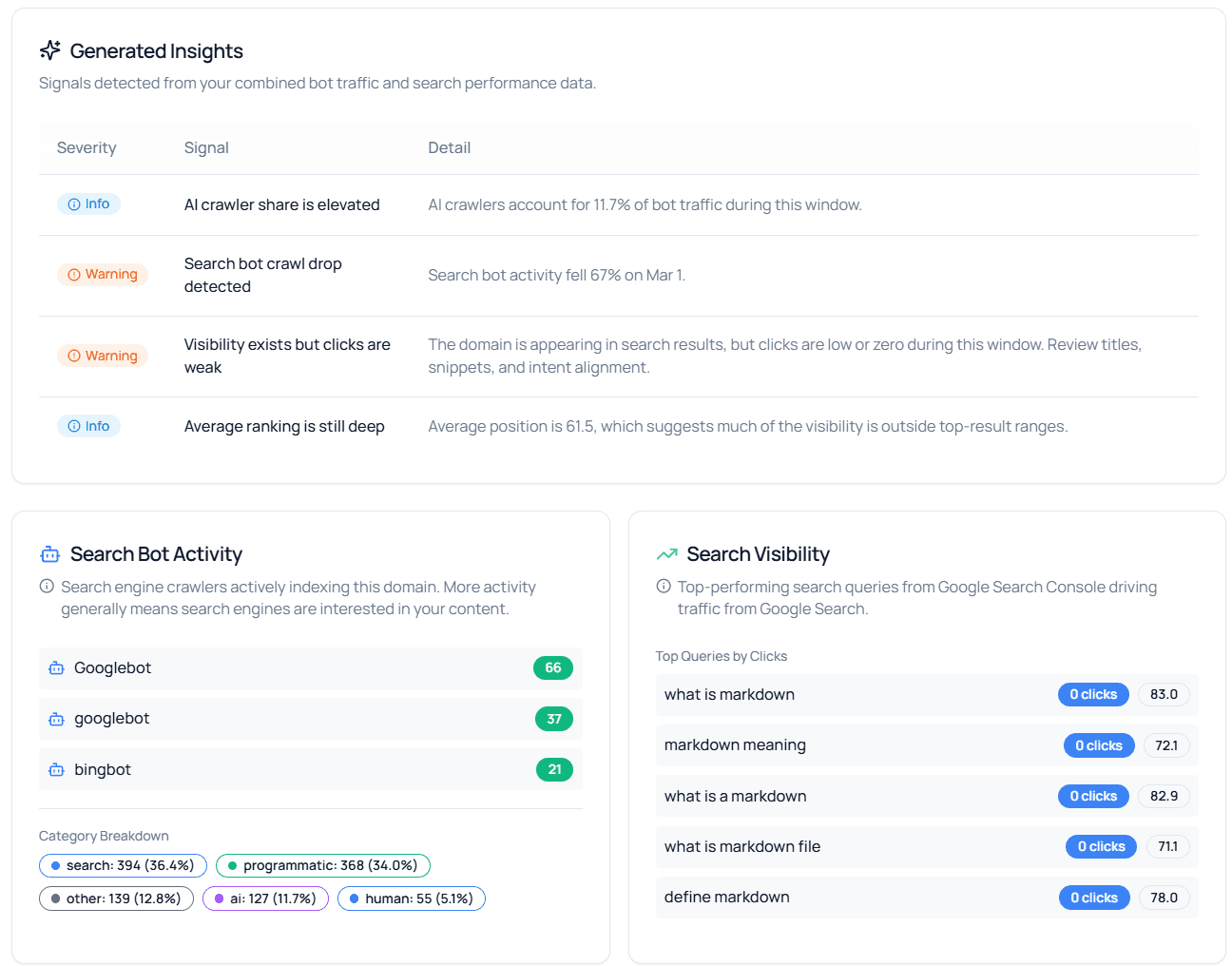
Automated signals detect crawl drops, elevated AI traffic, and weak click-through rates. See search bot counts, category breakdowns, and top queries side by side.
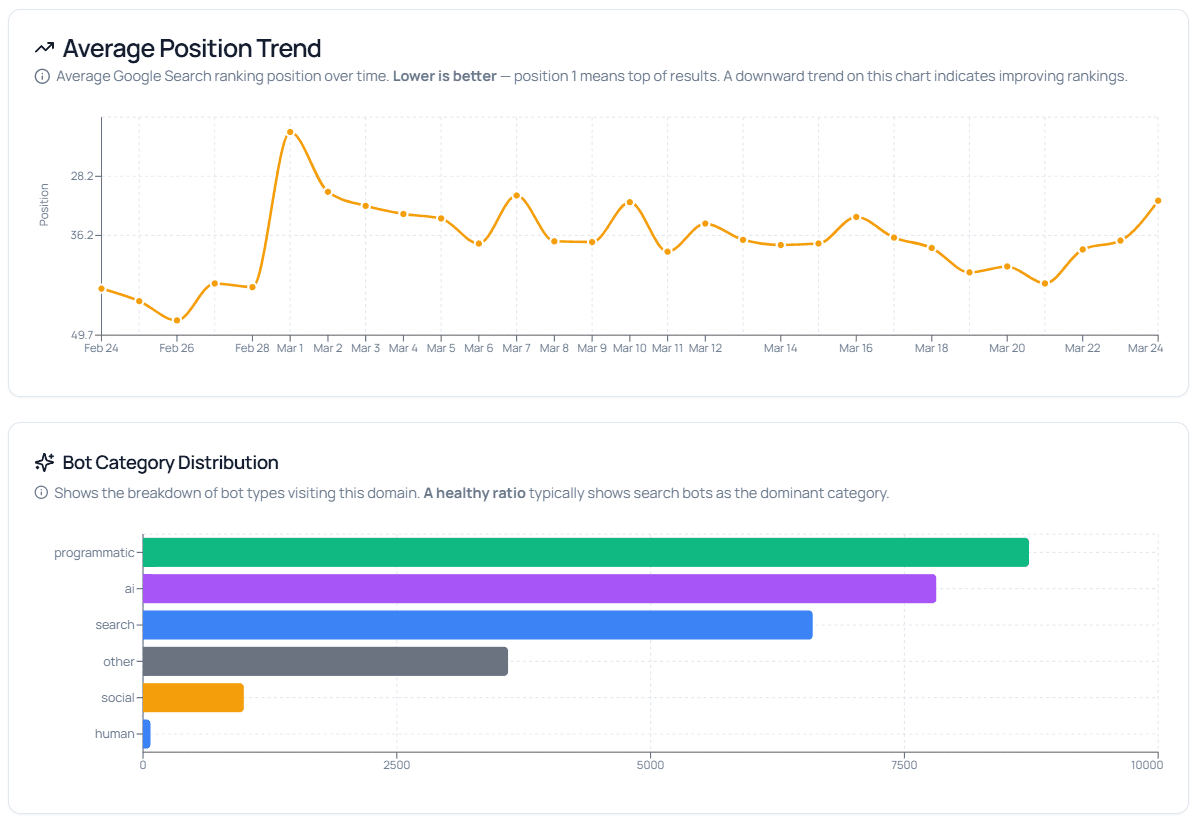
Track your average Google Search ranking position over time alongside the full breakdown of bot types visiting your domain — search, AI, programmatic, social, and more.
Everything you need to make a JavaScript app fully visible — in one platform.
Every route is rendered in a real browser and captured as stable, bot-friendly HTML.
Multi-layer detection identifies Googlebot, AI crawlers, and social bots — routing each to the right content.
Clean, structured Markdown served to LLMs for accurate summarization and citation.
Automatic SPA route discovery ensures bots see your entire site, not just the homepage.
301/302 redirects evaluated at the edge before your app loads — with chain and loop detection.
Track snapshot health, metadata changes, and crawl status across all your routes.
Continuous re-rendering keeps snapshots current as your content changes.
Ensure OG tags, Twitter cards, and social metadata render correctly for every share.
Your website already works for humans — we make it work for AI systems like ChatGPT, Claude, and Perplexity.
<div class="nav-wrap">
  <script src="app.js">
  </script>
  <div id="__next">
    <div class="css-1a2b3c">
      <div role="main">
        <h1>About Us</h1>
        <div class="content
          -block css-xyz">
<p>We build...# About Us We build tools that make JavaScript apps visible to every bot on the internet. ## Our Mission Ensure modern web apps are discoverable by search engines and AI.
Reduces AI context usage by ~91%
More of your site fits into AI prompts and retrieval windows.
Clean structure improves AI comprehension and citation accuracy.
Fewer tokens means cheaper AI processing for every query.
Built with Lovable, V0, or Bolt? Edge makes your site visible to search and AI without touching code.
Get full visibility into what bots actually see — without waiting on engineering.
Manage SEO visibility across multiple client SPAs from a single dashboard.
| Feature | DataJelly Edge | DIY / Custom | Rendertron / Prerender.io | Next.js Rewrite |
|---|---|---|---|---|
| Setup time | 5 minutes | Weeks | Hours | Months |
| Code changes | None | Extensive | Moderate | Full rewrite |
| AI crawler support | Full | None | None | Partial |
| Markdown delivery | Yes | No | No | No |
| Bot detection | Built-in | Manual | Basic | None |
| Redirect handling | Edge-level | App-level | None | Config |
| Route discovery | Automatic | Manual | Manual | Built-in |
| Social previews | Optimized | Manual | Basic | Manual |
| Ongoing maintenance | Zero | High | High | Moderate |
DataJelly Edge was retired in June 2026 and we are not accepting new customers. Have questions? We still love email.
DataJelly Edge is a visibility layer that sits in front of your existing JavaScript application. It routes humans to the live app while serving crawler-specific representations that are easier to index, cite, monitor, and share.
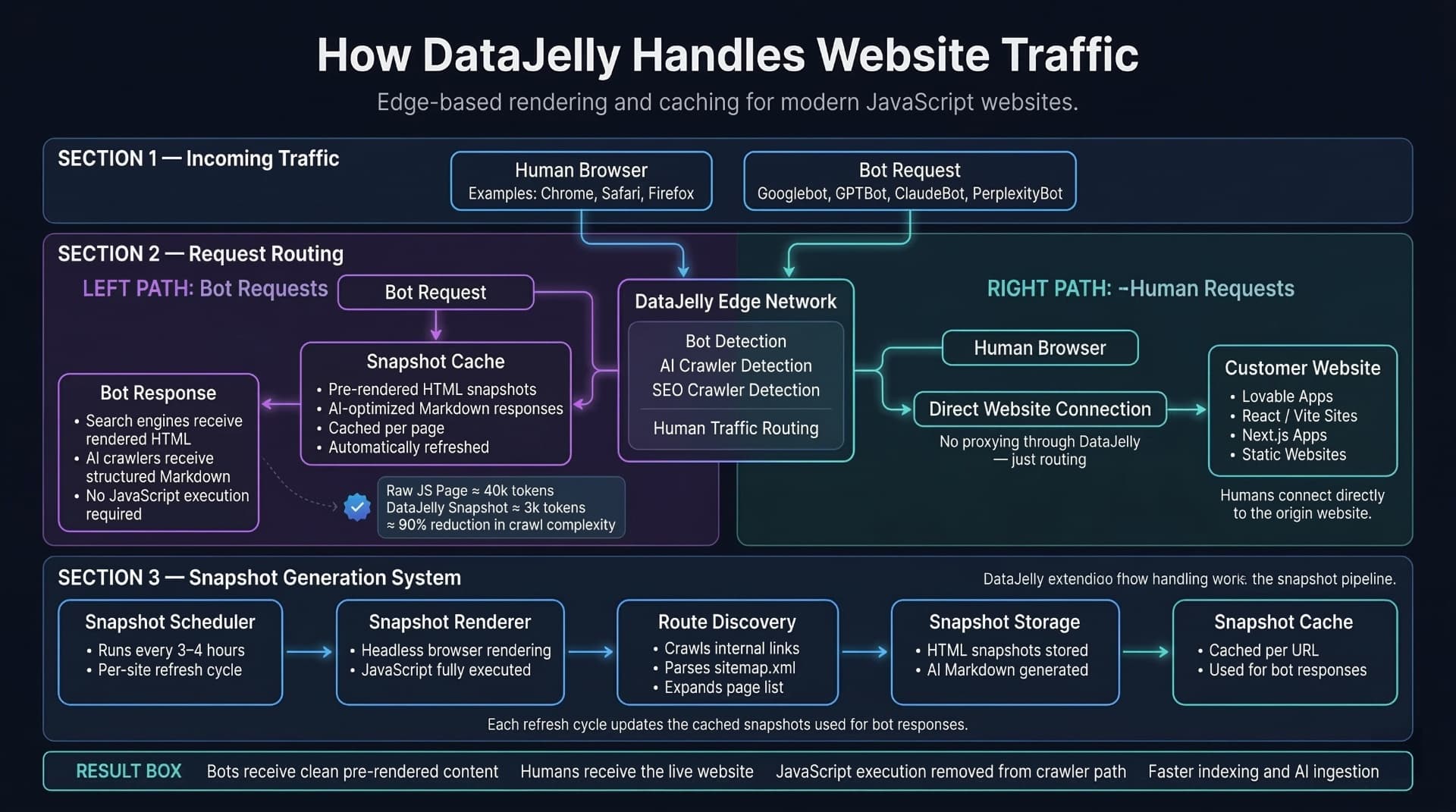
Full request lifecycle: traffic interception, visitor identification, and routing to the appropriate rendering pipeline.
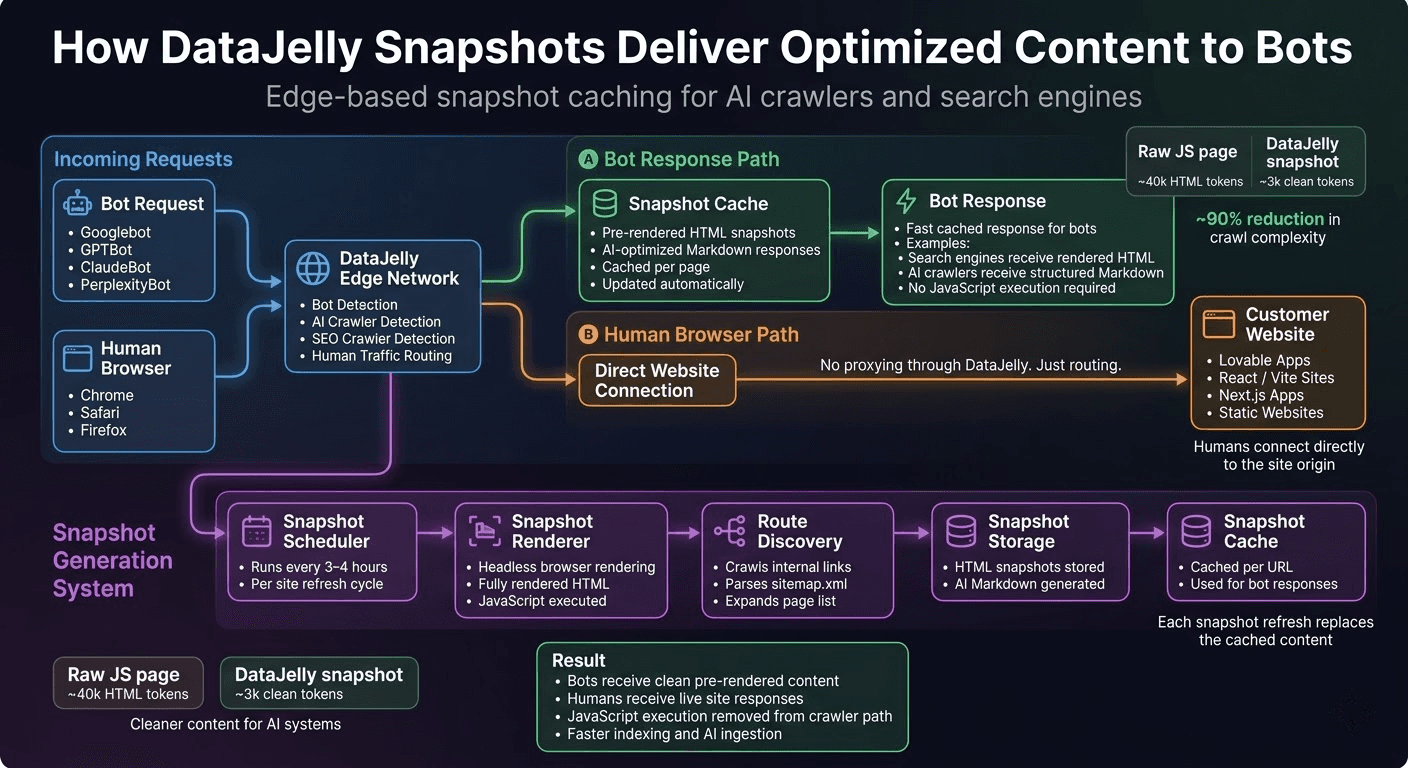
The snapshot generation and delivery pipeline — from headless rendering to optimized HTML and Markdown storage.
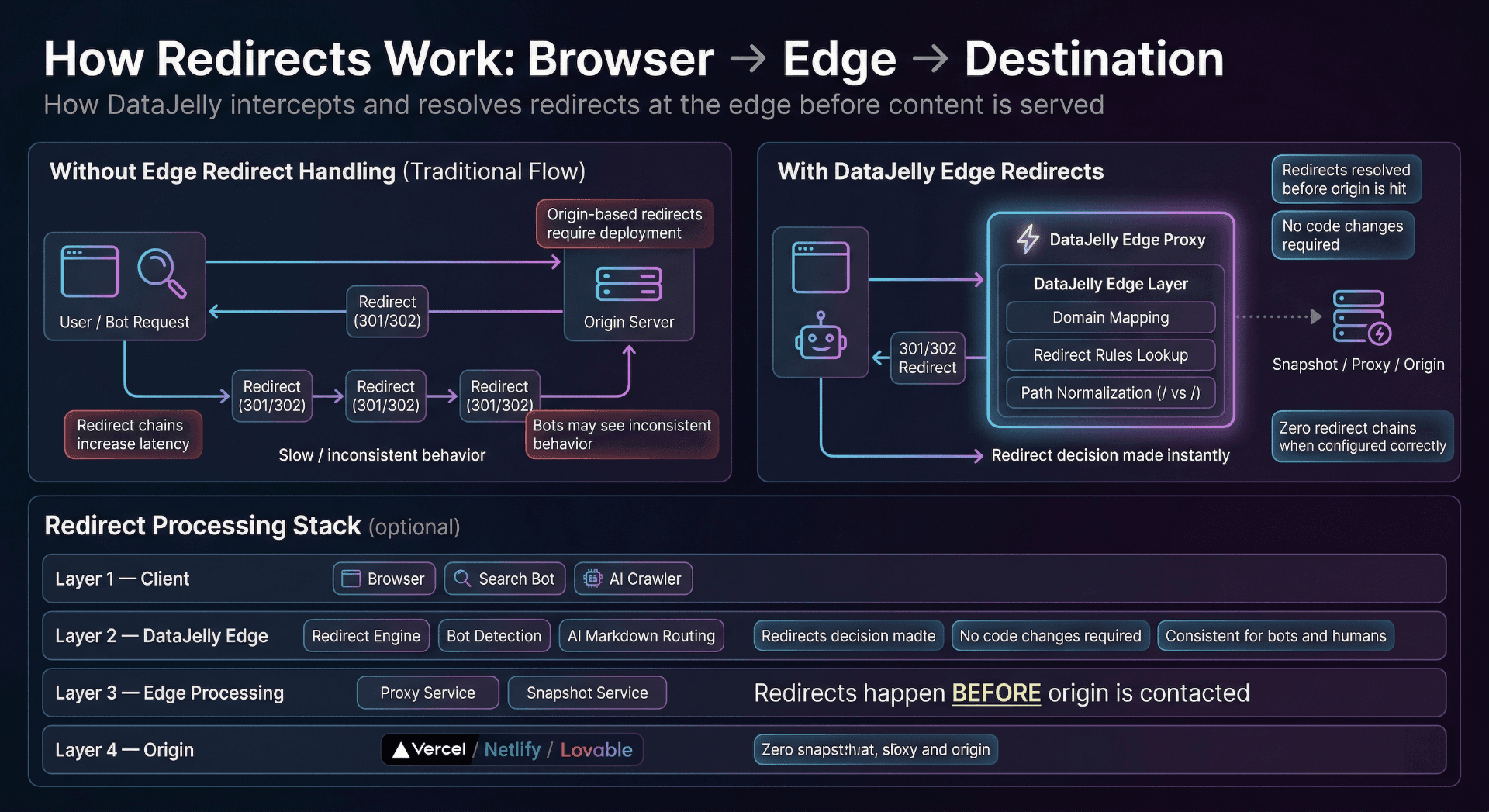
Redirect matching, chain resolution, and loop-detection logic at the network layer.
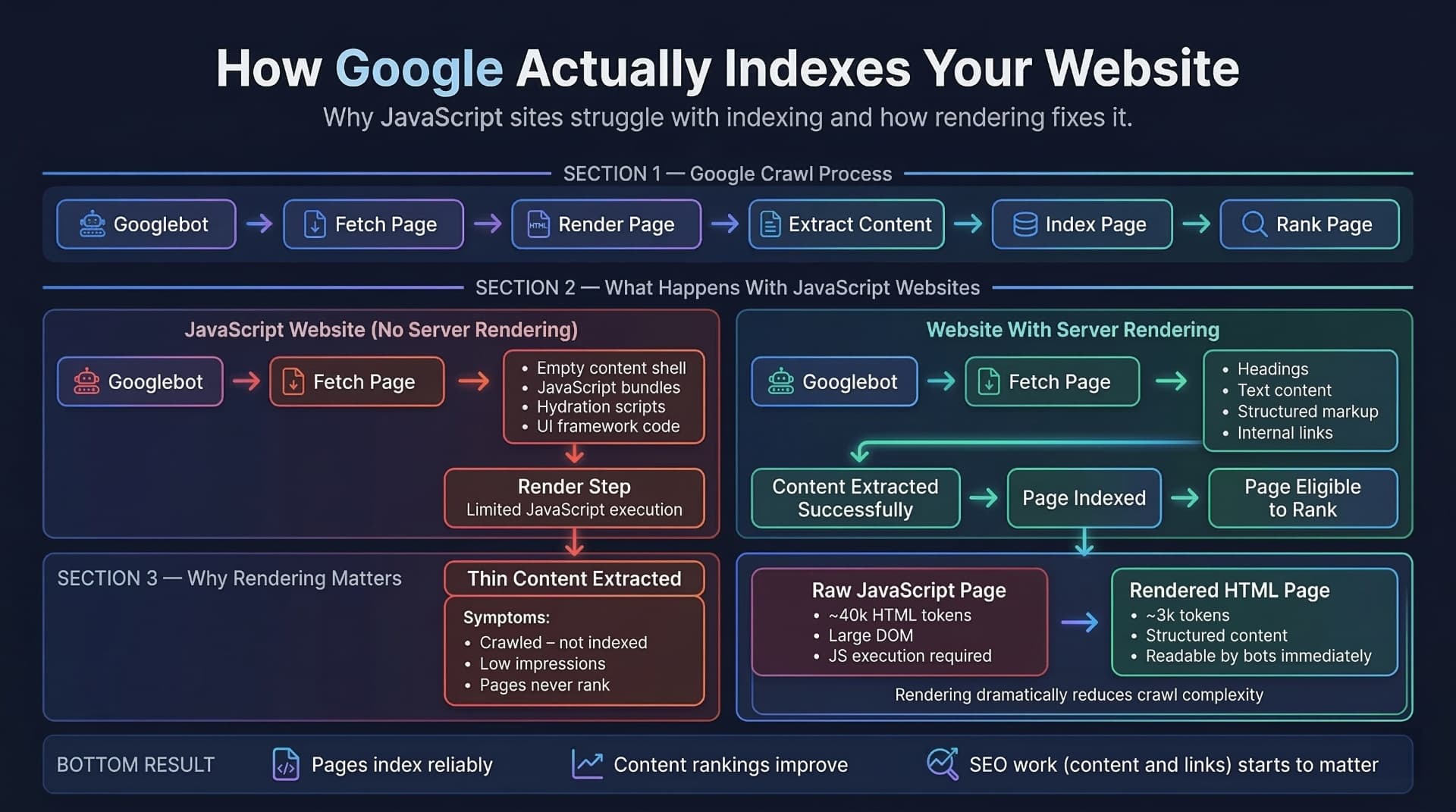
Google's two-phase indexing process and where JavaScript apps break down without prerendering.
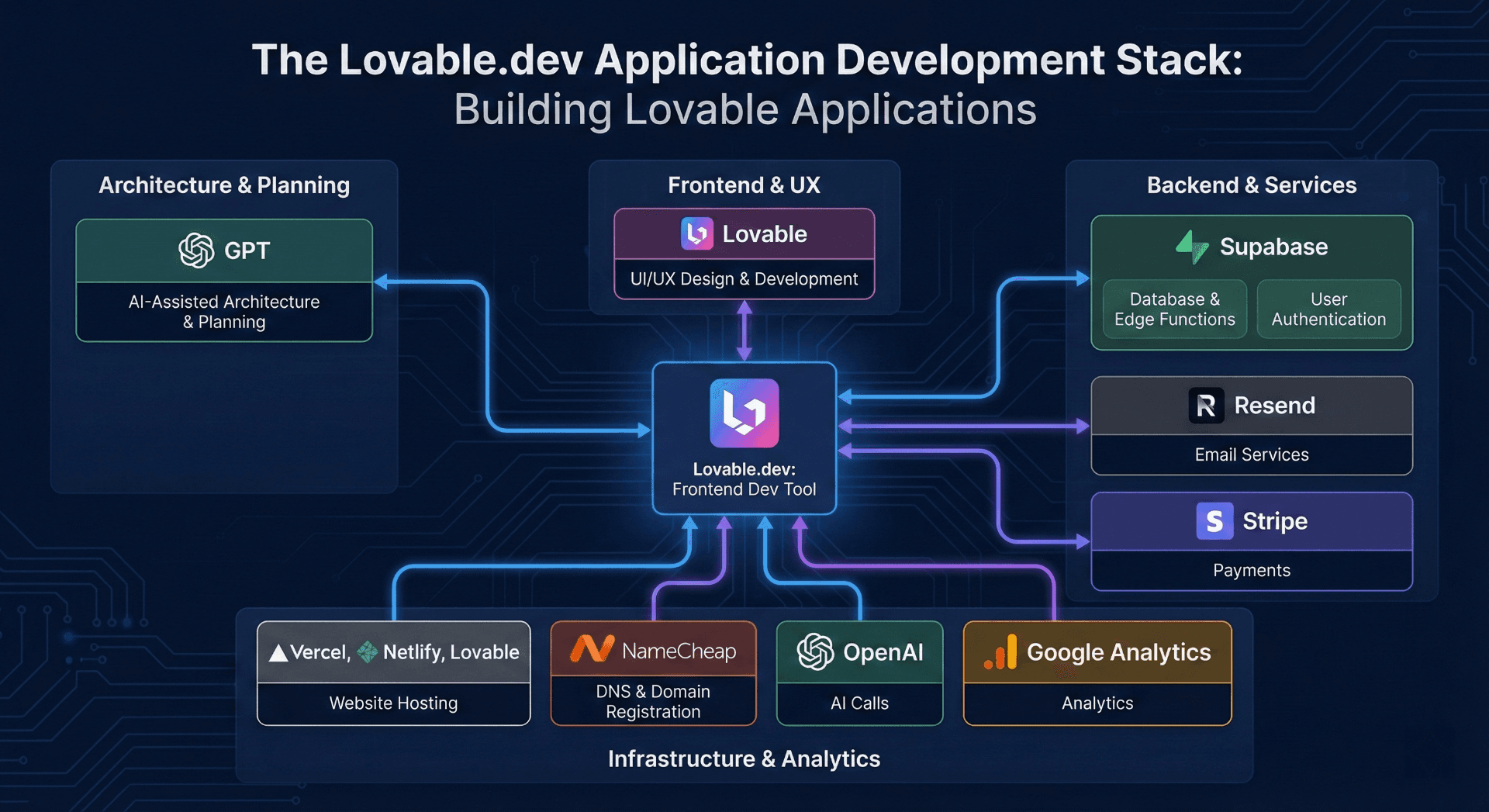
How Lovable apps are built — GPT for planning, Lovable for frontend, Supabase for backend, and the infrastructure layer underneath.
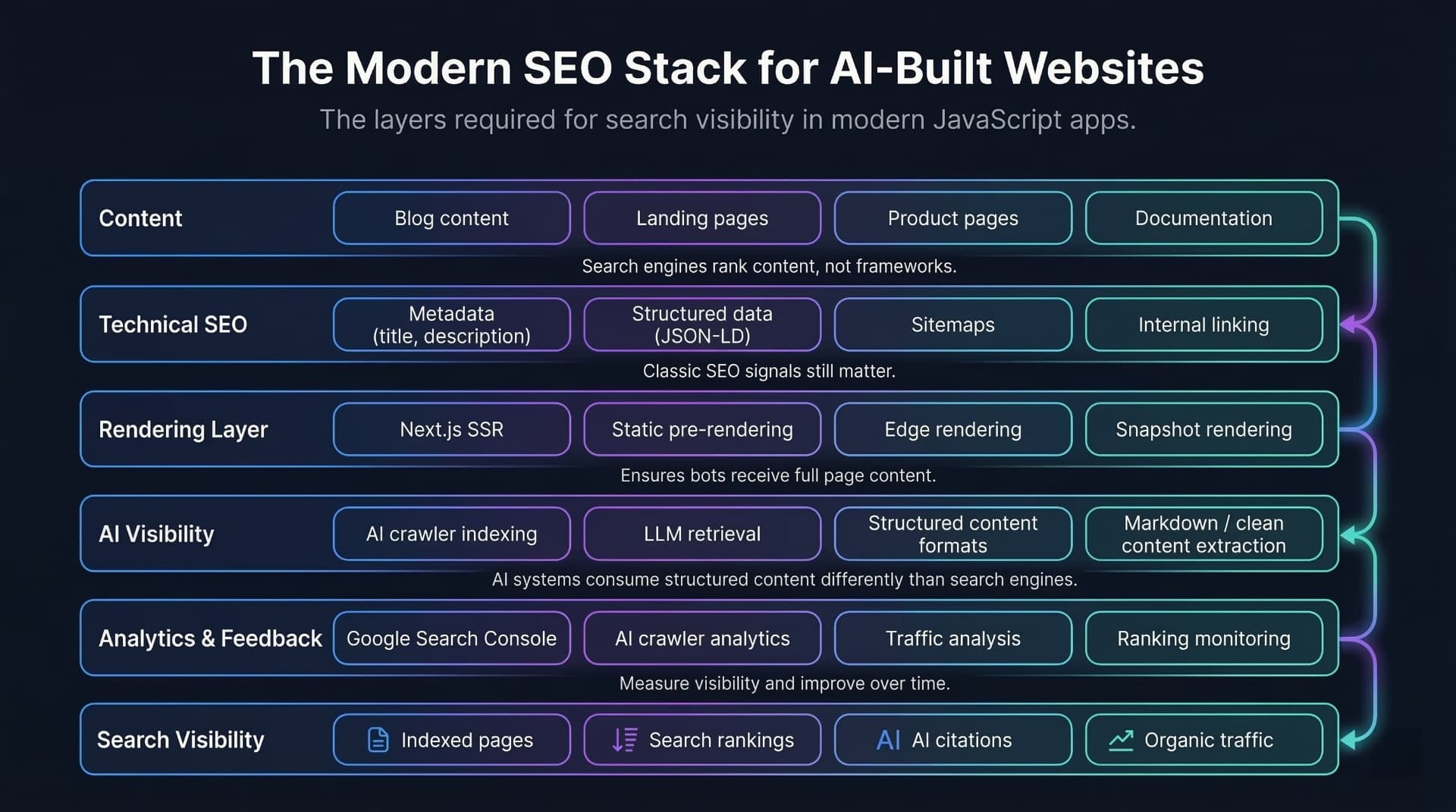
The full stack of layers required for search visibility in modern JavaScript apps — from content and technical SEO to rendering, AI visibility, and analytics.
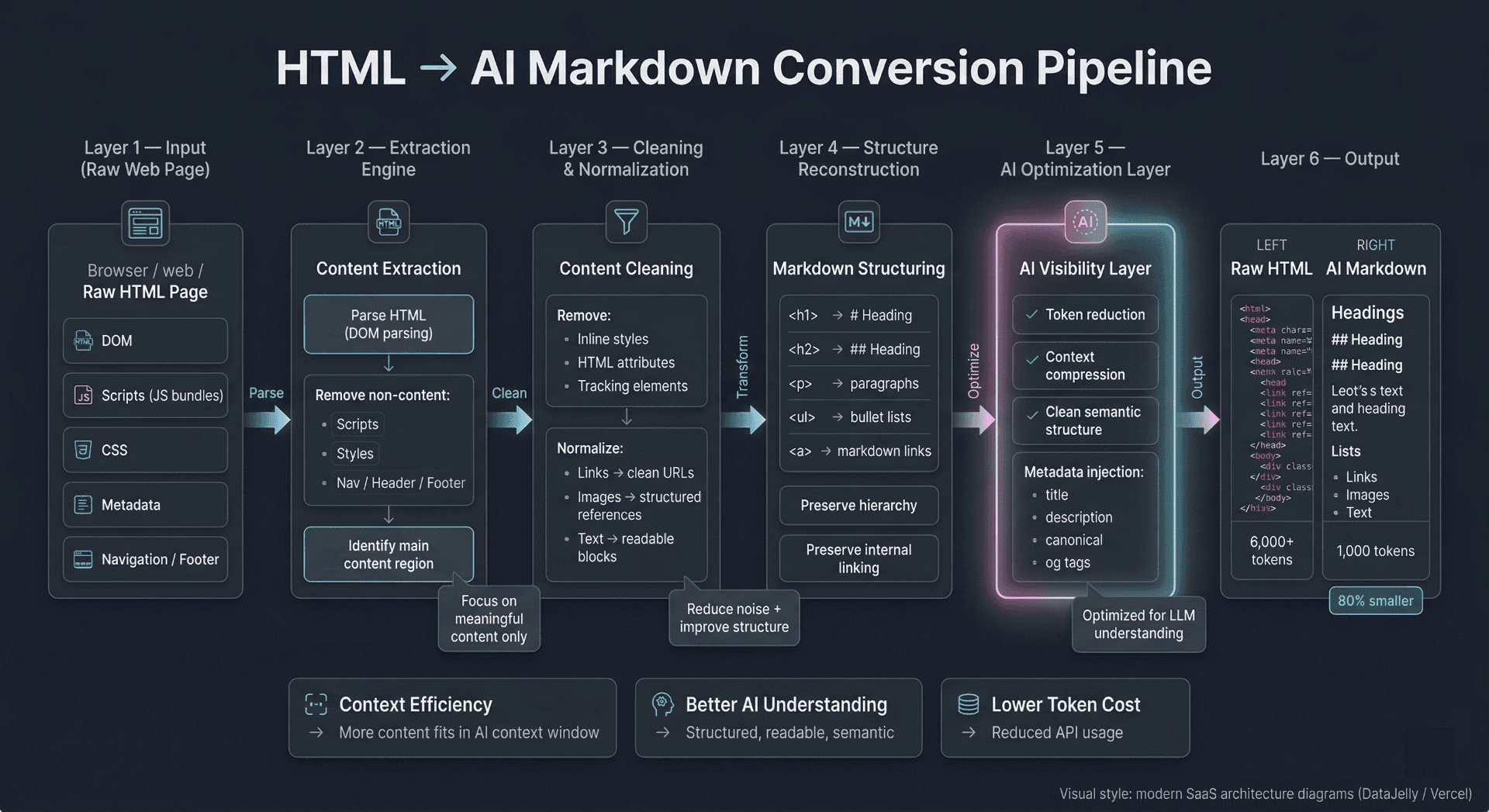
The 6-layer pipeline that transforms raw HTML into token-efficient Markdown — from DOM extraction and content cleaning to structure reconstruction and AI optimization.
DataJelly Edge is an edge-deployed visibility layer for JavaScript applications. It sits between your domain and your app, rendering pages for bots, detecting crawlers, managing redirects, and serving the right content format to every visitor type — all without code changes.
No. Edge works with your existing SPA as-is. You connect your domain via DNS, and Edge handles everything at the network layer. No framework migration, no SSR setup, no code changes.
Edge detects and serves optimized content to Googlebot, Bingbot, ChatGPT-User, PerplexityBot, ClaudeBot, Google AI Overview crawlers, social media bots (Twitter, LinkedIn, Facebook, Slack), and dozens more. We continuously update detection for new crawlers.
Traditional prerendering tools only serve HTML to search engines. Edge delivers four formats: HTML for search engines, Markdown for AI agents, metadata for social bots, and your unchanged SPA for humans. It also includes bot detection, redirect management, route discovery, and monitoring — built in.
No. Human visitors bypass Edge entirely and load your SPA directly. Only bots are routed through the rendering pipeline. There's zero performance impact on your users.
When an AI crawler like ChatGPT or Perplexity visits, Edge serves a clean Markdown version of your page — ~91% smaller than raw HTML. This helps LLMs accurately summarize and cite your content in AI-generated answers.
Yes. Edge evaluates 301/302 redirect rules at the network layer before your app loads. It supports bulk import, chain detection, loop prevention, and a full audit tool to validate your redirect setup.
Most users are fully connected in under 15 minutes. Point your domain to Edge via DNS, and snapshots begin generating automatically.
Edge is designed for client-side SPAs that lack SSR. If you already have Next.js with full SSR, you may not need Edge — but it can still add AI Markdown delivery, bot analytics, and redirect management.
Any JavaScript framework: React, Vue, Angular, Svelte, Vite, and platforms like Lovable, V0, Bolt.dev, Replit, and more.
You can connect your Google Search Console account directly in the DataJelly dashboard. Once linked, Edge overlays your organic search data — clicks, impressions, average position, and top queries — alongside bot traffic analytics. This lets you see how crawl activity correlates with ranking changes and spot visibility gaps in a single view.
Most sites are refreshed automatically every 4 hours — that's 6 times per day. You can also trigger a manual refresh at any time from the dashboard if you've just published new content or made changes you want bots to see immediately.
We respond to all major Search, AI, and Social bots based on the settings configured per domain. Edge does not respond to every bot indiscriminately — we only serve snapshot content to bots that drive AI citations, social link previews, or SEO search rankings. This includes Googlebot, Bingbot, GPTBot, ClaudeBot, PerplexityBot, FacebookExternalHit, TwitterBot, LinkedInBot, and dozens more. You can review the full list of supported crawlers in the dashboard.
Edge services were sunset in June 2026 and we are no longer accepting new customers. If you care about whether your live pages are actually working for users and bots, take a look at DataJelly Guard.