Redirects: Complete Guide for SEO & Edge Routing
Learn how redirects impact SEO, how they work at the edge, and how to manage them safely using DataJelly.
Browser / Bot
Requests /old-page
DataJelly Edge
Evaluates redirect rule
Destination
301 → /new-page
Why Redirects Matter
URLs change. Pages move, products get renamed, routes get cleaned up. Without redirects, every changed URL becomes a dead end — a 404 that loses traffic, breaks bookmarks, and throws away the SEO value you've built.
301 redirects transfer link equity and ranking signals to the new URL. Without them, you start from zero.
External sites, social shares, and bookmarks pointing to old URLs keep working instead of hitting 404s.
If the same content exists at multiple URLs, redirects tell search engines which version is canonical.
Redirects guide search engines and AI crawlers to the right content, preventing index bloat and confusion.
"Redirects are not optional — they are critical infrastructure for SEO and user experience."
Common Redirect Use Cases
Page moved
/pricing-old → /pricingThe most common case — you renamed or restructured a page.
URL cleanup
/product?id=123 → /product/123Clean up query-string URLs into readable paths.
Trailing slash normalization
/about → /about/Pick one format and redirect the other.
Canonical root
/home → /Consolidate homepage duplicates.
Domain migration
oldsite.com/* → newsite.com/*Move an entire site to a new domain.
Fixing broken links
/old-blog-post → /blog/updated-postRescue inbound links pointing to removed content.
Avoid redirect chains
If /a → /b → /c, update the rule so /a goes directly to /c.
Redirect Types
Keep it simple. There are really only two you need to know:
The page has moved permanently. Search engines transfer SEO value and update their index to the new URL.
The page is temporarily at a different URL. Search engines keep the original URL in their index.
When in doubt, use 301. It's the safe default for almost every redirect scenario.
Supported Redirect Format
Redirects in DataJelly are path-based and use relative paths only. Here's how they work:
Example:
/old-page  →  /new-page     (301)
/blog/old  →  /blog/new     (301)
/temp      →  /maintenance  (302)
Rules:
- Paths must start with
/ - No full URLs — only relative paths
- One redirect per source path
- No loops allowed — the system validates this automatically
How Redirects Work in DataJelly
DataJelly executes redirects at the edge proxy layer — the same infrastructure that handles bot detection and snapshot serving. This has several important implications:
Redirects fire at the edge before any rendering, snapshot logic, or origin request. Sub-millisecond response.
Your application code, hosting, and deployment pipeline remain unchanged. Redirects are managed entirely at the proxy layer.
Redirects apply to all traffic — human visitors, search engine crawlers, and AI bots all get the same redirect behavior.
Redirects run before the snapshot/rendering pipeline. No wasted compute on pages that should redirect.
"Redirects happen instantly at the edge — faster and more reliable than origin-based redirects."
Managing Redirects in DataJelly
Add a Redirect
Each redirect has three fields:
/old-page)/new-page)Bulk Import
Import multiple redirects at once using CSV format:
source,target,status
/old-page,/new-page,301
/blog/legacy,/blog/updated,301
/temp-promo,/summer-sale,302
Editing & Deleting
Existing redirects can be edited inline or deleted from the redirects management table. Changes take effect immediately at the edge — no deployment or cache purge needed.
Validation Rules
DataJelly validates every redirect before saving:
- No redirect loops allowed
- No duplicate source paths
- Only relative paths accepted
- Status code must be 301 or 302
Testing Redirects
You can verify redirects instantly using the DataJelly test system. Every account has built-in test paths you can use to confirm redirect behavior:
/flock1Basic redirect → /flock2
Confirms simple 301 redirect works
/flock-queryQuery parameter preservation
Confirms query strings are passed through
/flock-chain1Redirect chain behavior
Tests multi-hop redirect (chain detection)
/flock-loop1Loop detection
Confirms the system blocks infinite loops
Using curl to verify
# Check redirect status and destination
curl -I https://yourdomain.com/flock1

# Expected: HTTP/1.1 301 Moved Permanently
# Location: /flock2
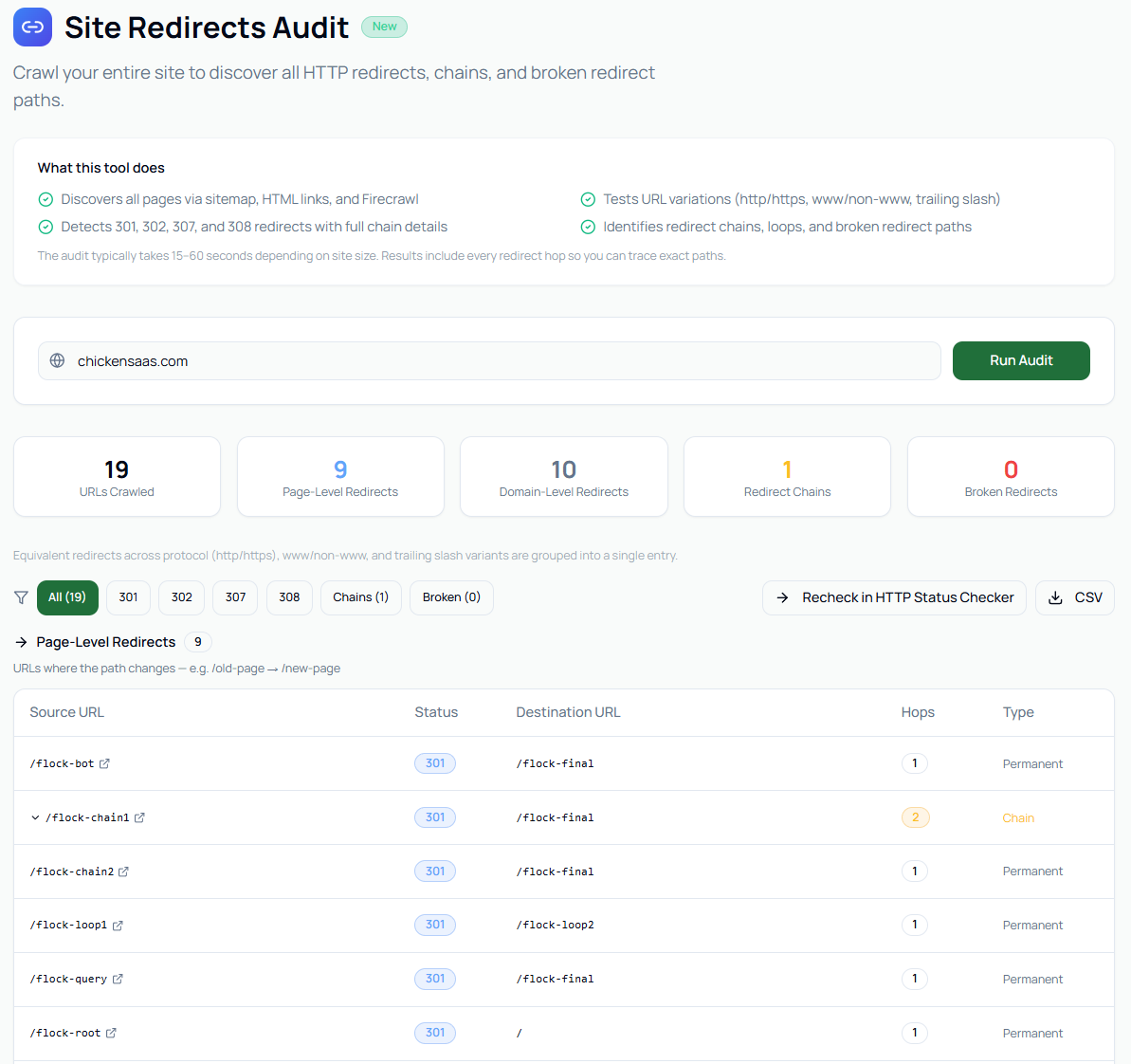
You can also use the Site Redirects Audit tool to discover all redirects across your entire site automatically.
Common Mistakes
Redirect chains
A → B → C wastes crawl budget and adds latency. Always redirect to the final destination.
Redirect loops
A → B → A creates an infinite loop. The browser gives up and shows an error.
Redirecting everything to homepage
Lazy redirects to / look like soft 404s to search engines. Redirect to the most relevant page.
Losing query parameters
Ensure important query strings (UTM params, filters) are preserved through redirects.
Inconsistent trailing slashes
Pick /about or /about/ and redirect the other. Don't serve both — it creates duplicate content.
Using 302 when you mean 301
Temporary redirects don't transfer SEO value. Use 301 for permanent moves.
Best Practices
How DataJelly Helps
DataJelly provides redirect management as part of its edge proxy infrastructure:
Edge-level redirect control
Redirects execute at the proxy before reaching your origin. No server changes needed.
No code changes required
Manage all redirects from the dashboard — your application stays untouched.
Safe validation
Loop detection, duplicate prevention, and path validation built in.
Built-in test system
Verify redirect behavior with test paths before going live.
Instant propagation
Changes take effect immediately — no deploy, no cache purge.
Related Tools
Redirects Audit Tool
Crawl your site and find all redirects, chains, and broken paths.
HTTP Status Checker
Bulk check HTTP status codes and redirect chains for any list of URLs.
Site Crawler
Discover all pages and links on your site.
Sitemap Validator
Ensure your sitemap URLs aren't pointing to redirected or broken destinations.
Related Guides
Search Engine Crawling Guide
Understand how crawlers discover, follow, and index redirects across your site.
JavaScript SEO Guide
Learn why JS-rendered sites need special attention for redirects and crawlability.
Bots: The Complete Guide
See which bots are crawling your site and how they handle redirect chains.
Google Search Console Guide
Use Search Console to identify redirect issues flagged by Googlebot.
Dynamic Rendering vs Prerendering
Compare rendering strategies and how they interact with edge-based redirects.
Social Previews Guide
Ensure redirects don't break Open Graph and social card previews.