Static File Monitoring: Sitemaps, Robots.txt, and AI Visibility Files
Some of the most important SEO files on your site are not normal pages. When sitemap.xml, robots.txt, or llms.txt break, the site can look fine in a browser while crawlers lose context.
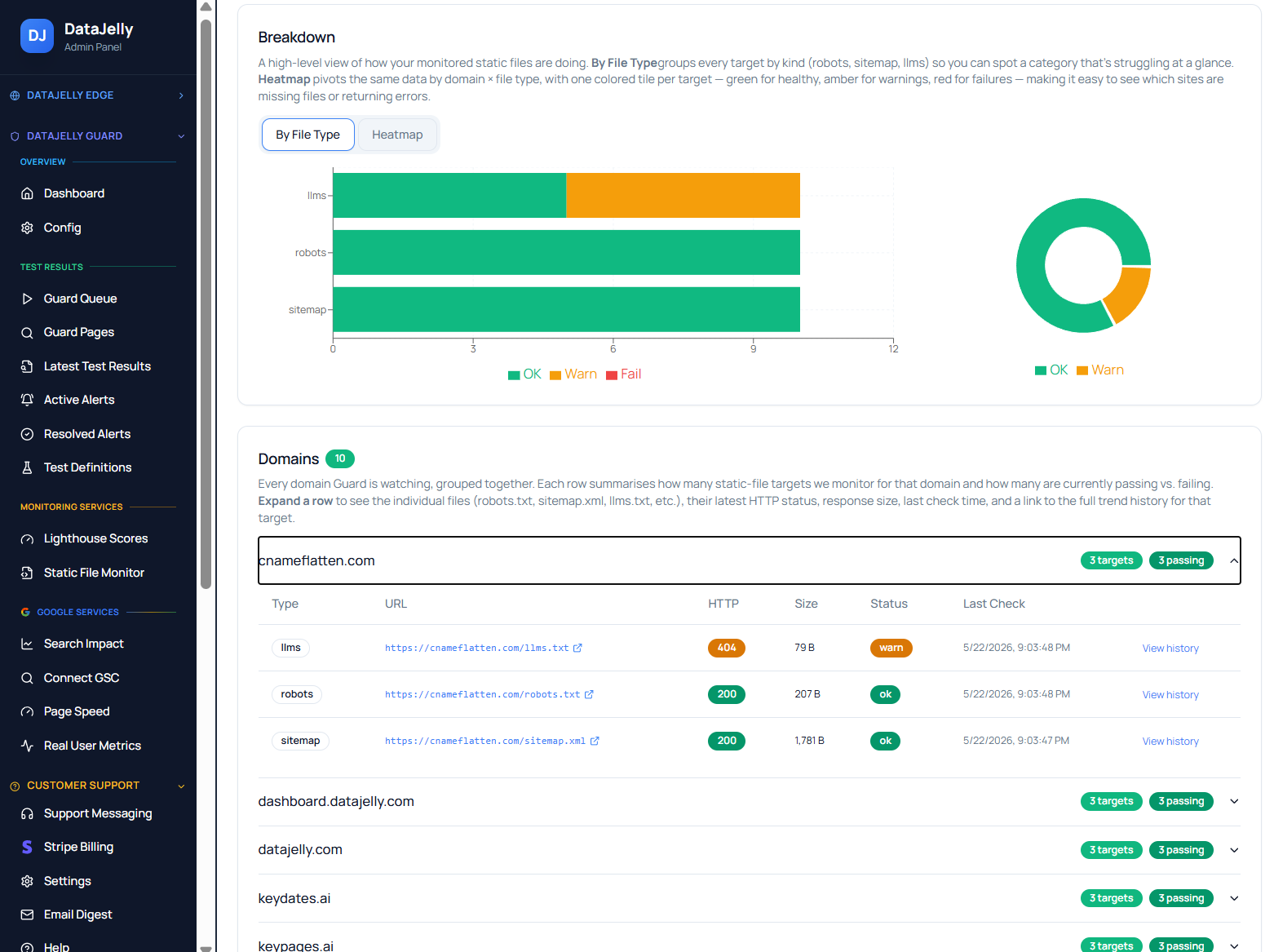
Your sitemap tells crawlers which URLs to discover. Your robots.txt tells crawlers what they can request. Your AI-facing files, such as llms.txt, help explain your site to AI crawlers and retrieval systems. Static File Monitor watches all of them so silent file failures do not become visibility problems.
Why static files matter
sitemap.xml
Helps search engines discover important URLs, especially new, updated, deep, or hard-to-find pages. It is a strong hint, not a guarantee of crawling.
robots.txt
Controls which paths crawlers can request. Powerful and risky — one bad deploy can accidentally block important areas of a site.
llms.txt
An AI visibility file pattern that gives AI systems a clear summary of useful content. Treat it as AI-context infrastructure, not a replacement for SEO fundamentals.
What DataJelly checks
Static File Monitor fetches the target file, records the response, and validates it against rules for that file type. It also records response time, content hash, failed rule count, summary data, and a preview payload where appropriate.
| File | What DataJelly checks | Why it matters |
|---|---|---|
| sitemap.xml | Fetch success, XML parse, expected sitemap root, URL or sitemap entries. | Crawlers need a valid map of important URLs. |
| robots.txt | Fetch success, text format, user-agent and directive presence, sitemap references. | Crawlers need clear access instructions. |
| llms.txt | Fetch success, markdown-style content, not an HTML error page. | AI crawlers and LLM systems need clean context. |
Common failure patterns
HTML returned instead of XML or text
A framework routes every unknown path to the app shell, so /sitemap.xml or /llms.txt returns a pretty page instead of the actual file.
Empty sitemap
The sitemap exists but contains no useful URL entries, so crawlers get a file that looks present but does not help discovery.
Robots.txt blocks important paths
A staging rule, wildcard, or generated robots file blocks real production routes, so crawlers may be unable to request content you want indexed.
Sitemap points at old URLs
The file is valid but stale, so crawlers are encouraged to visit redirects, retired pages, or the wrong canonical URLs.
llms.txt is missing or returns an app shell
The file is not configured as a static asset, so AI systems do not receive the concise markdown context you intended to provide.
How to use Static File Monitor
1. Watch the required files first
Start with /sitemap.xml and /robots.txt. These are the highest-leverage crawler files.
2. Add AI visibility files where useful
If your site publishes llms.txt, monitor it too. Make sure it is plain markdown-style content, not a rendered app route or HTML fallback.
3. Review failures like incidents
If a sitemap or robots target fails, treat it as more than a content bug. Ask whether a deploy changed static asset routing or whether the framework started serving the app shell for file paths.
4. Connect to Index Monitor
If Index Monitor shows unknown pages and Static File Monitor shows sitemap or robots issues, investigate them together. Discovery and access problems show up as indexing problems later.
The DataJelly angle
Guard watches pages. Static File Monitor watches the crawler infrastructure around those pages.
Together they answer two different questions: is the page healthy, and can crawlers discover and request the page correctly? You need both.
When to treat a failure as urgent
- Did a deploy change static asset routing?
- Did the framework start serving the app shell for file paths?
- Did the file content change unexpectedly?
- Are important pages blocked or missing?
- Does the sitemap reference canonical URLs?
Stop silent crawler-file failures
Monitor sitemap.xml, robots.txt, and llms.txt for availability and validity so a single deploy never quietly blocks discovery or AI context.
Frequently asked questions
Does a sitemap guarantee indexing?
No. A sitemap is a hint, not a guarantee. Google may choose whether and when to crawl or index the URLs.
Can robots.txt prevent indexing?
Robots.txt can prevent crawling. It is not the right tool for removing a URL from the index. For indexing control, use noindex or access control where appropriate.
Is llms.txt required for SEO?
No. llms.txt is not a Google SEO requirement. It is an AI visibility and machine-readable context pattern.
Why monitor static files if they rarely change?
Because when they do break, the failure can be quiet. The browser homepage may look fine while crawlers lose the map, rules, or AI context files they rely on.
Keep reading
Guard Test Catalog
The full searchable reference of every test, with severity and how-to-fix guidance.
Index Monitor
Discovery and access problems become indexing problems.
Guard Test Suite
Page-level checks that complement static file monitoring.
Google Search Console + Guard
Connect crawler access to real search demand.
Robots.txt Tester
Check exactly what your robots rules allow and block.